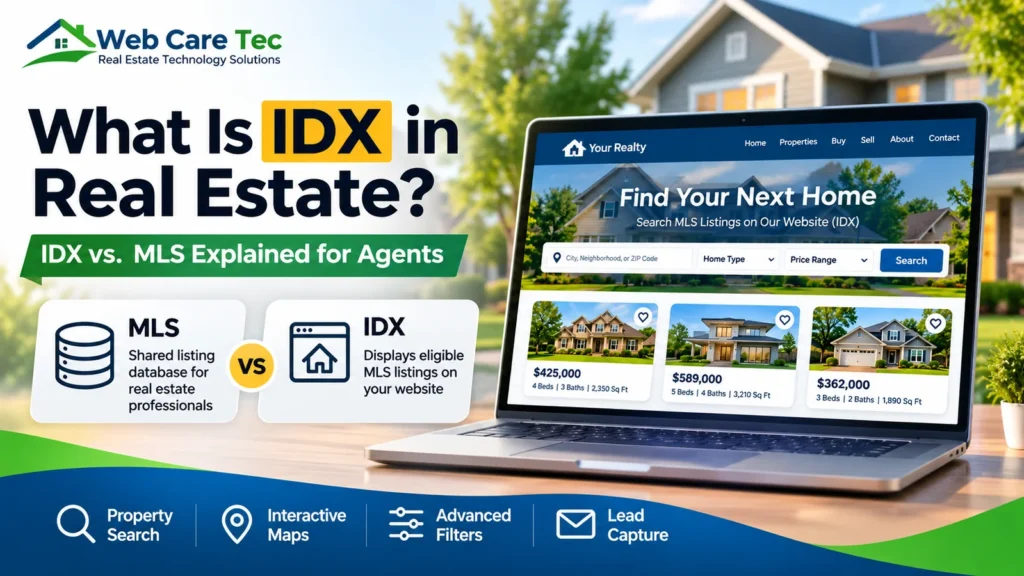
What is IDX in real estate? If you have ever searched for homes on a real estate agent’s website, you have probably used an IDX-powered property search without realizing it.
Many real estate agents want their websites to do more than display their contact information and introduce their services. They want visitors to browse available properties, explore listings, and get in touch when they find a home they like.
That is where IDX comes in.
IDX allows participating real estate professionals to display eligible property listings from their Multiple Listing Service (MLS) on their websites, subject to the applicable MLS rules and permissions.
Although IDX and MLS are closely connected, they are not the same thing. Understanding the difference can help you make better decisions when building or improving your real estate website.
In this guide, we will explain what is IDX in real estate, how it works with MLS, what an IDX website offers, and what agents should consider before choosing an IDX solution.
What Is MLS in Real Estate?
MLS stands for Multiple Listing Service. It is a system used by real estate professionals to share property listing information and cooperate with other agents and brokers.
When an agent lists a property, the listing information is entered into the relevant MLS according to its rules. Other authorized professionals can then access that information to help clients find properties, arrange showings, and complete transactions.
An MLS listing may contain information such as:
- Property address and location
- Asking price
- Number of bedrooms and bathrooms
- Property type and square footage
- Property descriptions and photographs
- Listing status and other relevant details
MLS systems are generally organized around local markets. Different regions may have different MLS organizations, membership requirements, data access arrangements, and listing rules.
For real estate agents, the MLS is an important professional resource. It helps them share property information with other participants rather than relying only on listings from their own brokerage.
The National Association of REALTORS® provides an overview of how Multiple Listing Services support real estate professionals.
What Is IDX in Real Estate?
IDX stands for Internet Data Exchange.
It refers to a set of policies and arrangements that allow participating MLS professionals to authorize the display of eligible listing information on websites and other approved digital platforms controlled by participating brokers.
In simple terms, IDX makes it possible for a real estate agent or brokerage to display qualifying property listings from the MLS on its own website.
For example, imagine a real estate agent in Houston has a WordPress website. Instead of manually adding every property, the agent can use an approved IDX solution to display eligible listings from the relevant MLS.
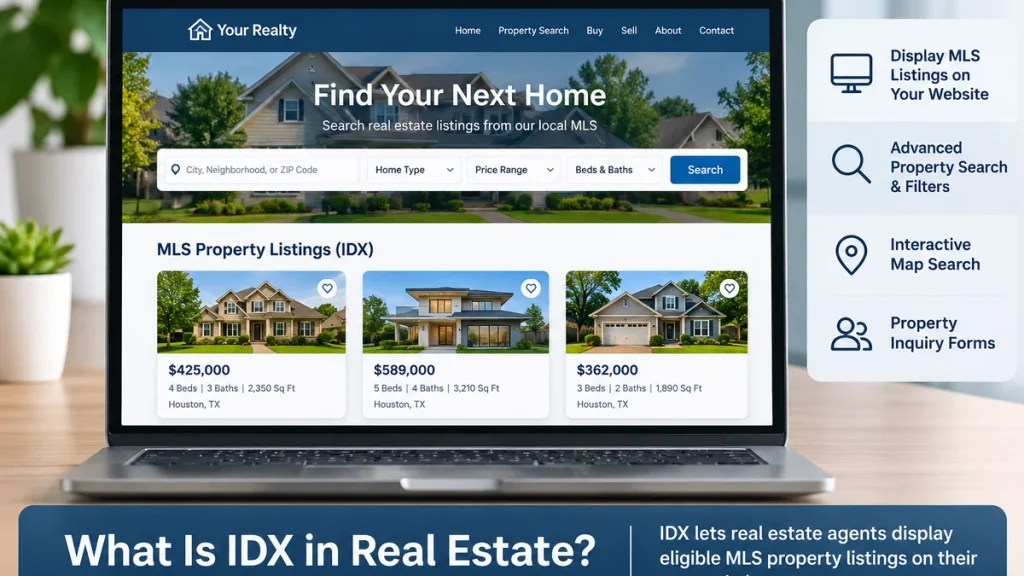
Website visitors may then be able to:
- Browse available properties.
- Search by city, neighborhood, or ZIP code.
- Filter listings by price and property type.
- View property photographs and details.
- Submit an inquiry about a property.
The exact features depend on the IDX provider, the MLS, the data license, and the applicable display rules.
The important distinction is that IDX is not another MLS database. It provides a permitted way to display eligible MLS listing information on participating websites.
The National Association of REALTORS® IDX policy resources explain the framework behind these displays.
What Is an IDX Website?
An IDX website is a real estate website that includes property search functionality powered by an authorized IDX integration.
Rather than showing only an agent’s own listings, an IDX-enabled website can display eligible listings from participating MLS members, depending on the local MLS rules and permissions.
This gives visitors a more useful way to explore properties without leaving the agent’s website.
A well-designed IDX website may include several features.
Property Search and Filters
Visitors can search for properties using criteria such as:
- City, neighborhood, or ZIP code
- Price range
- Number of bedrooms and bathrooms
- Property type
- Listing status
- Other filters supported by the IDX provider
These options help visitors narrow down their search instead of scrolling through unrelated properties.
Property Listing Pages
Individual listing pages provide more information about a property.
Depending on the available MLS data and display permissions, these pages may include photographs, property descriptions, pricing, features, and other listing details.
Interactive Maps
Some IDX solutions offer map-based property searches. Visitors can explore listings by location and get a better understanding of where properties are situated.
Property Inquiry Forms
An IDX website can include inquiry forms that allow visitors to ask questions about a property or request additional information.
These forms create an opportunity for agents to connect with people who are actively exploring the market.
Mobile-Friendly Property Search
Many visitors browse properties on their phones. An IDX website should therefore provide a convenient experience across desktops, tablets, and mobile devices.
Search filters, property images, listing details, and inquiry forms should remain easy to use on smaller screens.
IDX vs. MLS: What’s the Difference?
IDX and MLS work together, but they serve different purposes.
The simplest way to understand the difference is this:
MLS is the system real estate professionals use to share listing information. IDX is a framework that allows eligible MLS listing information to be displayed on participating websites.
Here is a side-by-side comparison.
| Feature | MLS | IDX |
|---|---|---|
| Meaning | Multiple Listing Service | Internet Data Exchange |
| Main purpose | Sharing property listing information among real estate professionals | Permitted display of eligible listings on participating websites |
| Primary users | Authorized real estate professionals | Participating brokers and website visitors |
| Listing information | Maintains and organizes MLS listing data | Uses eligible MLS listing data for approved displays |
| Website property search | Not its primary purpose | Enables property search on participating websites |
| Data access | Governed by MLS membership and access rules | Governed by IDX participation, permissions, and MLS rules |
| Main benefit | Supports listing cooperation and information sharing | Makes eligible property listings available to website visitors |
Is IDX the Same as MLS?
No. IDX and MLS are related, but they are not interchangeable.
An MLS is the listing service where real estate professionals share property information. IDX is one of the ways eligible listing information can be displayed online under the applicable rules.
Think of the MLS as the source of the listing information and IDX as an authorized way to present some of that information on a real estate website.
Understanding this distinction is important when choosing a website platform or discussing an integration with an IDX provider.
How Do IDX and MLS Work Together?
IDX connects the listing information maintained by an MLS with a participating real estate website.
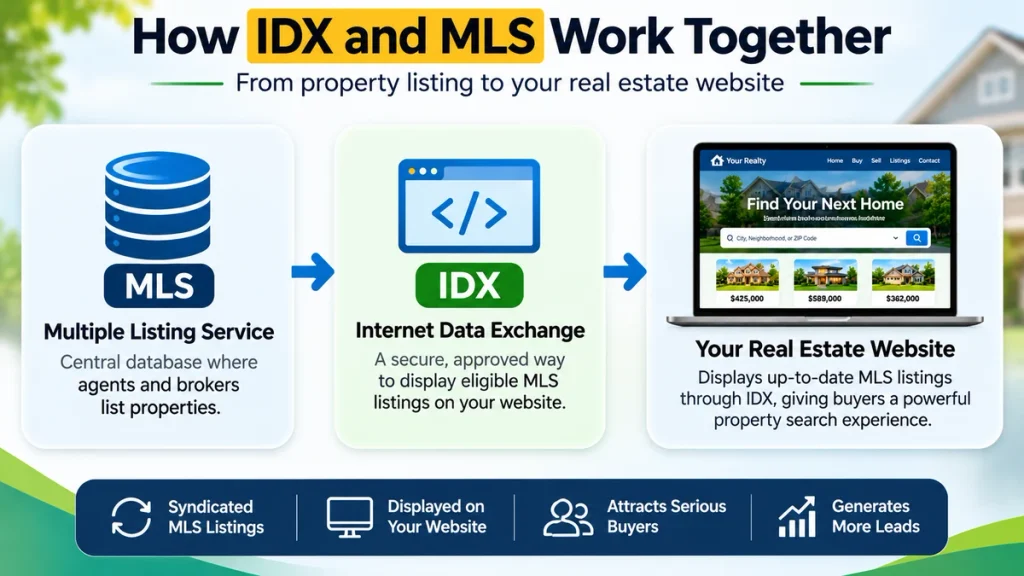
Although the technical process varies by provider and MLS, the general process looks like this:
1. A property is entered into the MLS
A listing agent submits property information to the relevant MLS according to its listing requirements.
2. The MLS maintains the listing information
The MLS stores and manages the listing data, including information such as property details, photographs, price, and status.
3. An authorized IDX solution accesses eligible data
An IDX provider or integration receives access to the listing information it is authorized to use under the relevant MLS data agreement and technical requirements.
4. Listings are displayed on the real estate website
The IDX solution presents eligible listings through property search results and individual listing pages.
5. Visitors search and submit inquiries
Potential buyers can browse properties and contact the agent or brokerage through available inquiry options.
When a listing is updated, the IDX system must reflect changes according to the MLS data access and refresh requirements.
This process reduces the need for agents to manually add and update every eligible property on their websites.
Benefits of IDX Integration for Real Estate Agents
An IDX integration can make a real estate website more useful by combining the agent’s online presence with property search functionality.
Here are some of the main benefits.
1. Display More Property Listings
Without an IDX integration, an agent may have to rely on manually adding properties or displaying only selected listings.
An approved IDX solution can make eligible listings from participating MLS members available on the website. This gives visitors more properties to explore.
2. Create a Better Property Search Experience
Visitors want to find properties that match their requirements.
With search filters, location-based searches, and individual listing pages, an IDX website can make the browsing process more convenient.
3. Give Visitors a Reason to Return
A useful property search experience can encourage visitors to revisit an agent’s website when they want to explore new listings or check property information.
The website becomes a resource for property research rather than simply an online business card.
4. Generate Relevant Property Inquiries
When visitors find properties they are interested in, they may want to request additional information or arrange a showing.
Well-placed inquiry forms and contact options make it easier for them to reach the agent.
5. Support Local Real Estate Marketing
An IDX website can be combined with neighborhood pages, community information, and location-specific content.
For example, an agent serving several communities can create useful pages that introduce each area and provide visitors with relevant property search options.
IDX does not automatically guarantee search rankings, but it can support a broader website strategy when combined with helpful content, good site structure, and technical SEO.
How to Add IDX to a Real Estate Website
Adding IDX to a real estate website involves more than installing a plugin or pasting a search link.
You need to choose a compatible solution, confirm MLS access, configure the integration, and make sure the property search works properly.
Here is a practical overview.
Step 1: Identify Your MLS
Start by identifying the MLS that serves your market.
Not every IDX provider supports every MLS. Before choosing a solution, confirm that the provider works with your specific MLS and supports the features you need.
Step 2: Choose an IDX Provider
Compare providers based on:
- MLS coverage and compatibility
- Available property search features
- Website platform support
- Design and customization options
- Pricing and ongoing fees
- CRM and lead management capabilities
- Technical support
Do not choose a provider based only on its advertised features. Confirm that it supports your market and meets the requirements of your brokerage and MLS.
Step 3: Complete the Required Authorization
IDX access is subject to MLS participation requirements, data agreements, and applicable permissions.
Depending on the MLS, you may need broker approval, an IDX application, a data license, or other documentation before the integration can be activated.
Your provider or MLS can explain the requirements for your market.
Step 4: Connect IDX to Your Website
Once access is approved, the IDX provider can configure the connection using its supported integration method.
For WordPress websites, this may involve a dedicated plugin, an embedded search experience, or another provider-supported integration.
The technical approach depends on the provider and the website setup.
Step 5: Configure Property Search and Listing Pages
After connecting IDX, configure the website experience.
This may include:
- Property search forms
- Search filters
- Listing result layouts
- Individual property pages
- Map-based searches
- Inquiry forms
- Agent and brokerage information
The goal is to make property search feel like a natural part of the website rather than a disconnected third-party feature.
Step 6: Test the Integration
Before launching, test the website on desktop and mobile devices.
Check that:
- Property searches return relevant results.
- Filters work correctly.
- Listing details display properly.
- Property images load.
- Inquiry forms submit successfully.
- Contact information is accurate.
- Listing attribution and required disclosures are visible.
Also confirm that the integration follows the applicable MLS display and data-use rules.
Popular IDX Solutions for Real Estate Websites
There are several IDX solutions available for real estate agents and brokerages. Each has different features, integrations, supported MLS markets, and pricing arrangements.
Here are some providers worth evaluating.
IDX Broker
IDX Broker offers property search and listing display solutions for real estate websites. It is commonly considered by agents and brokerages looking for IDX functionality with website customization options.
Showcase IDX
Showcase IDX provides property search and listing experiences for real estate websites, including WordPress-focused integrations.
Agents should evaluate its search experience, available features, and MLS coverage before choosing it.
Realtyna
Realtyna offers real estate website solutions and IDX-related integrations, including options for WordPress websites.
It may be worth considering when website customization and integration flexibility are important.
iHomefinder
iHomefinder provides real estate search and IDX solutions with features for displaying property listings and capturing inquiries.
Its available features and MLS support should be checked for the target market.
Flexmls
Flexmls is an MLS platform that may provide tools and integration options depending on the MLS organization and its arrangements.
It is important to distinguish the Flexmls platform from a standalone IDX provider. The available website integration options depend on the relevant MLS and its approved services.
Which IDX provider should you choose?
There is no single provider that is best for every agent.
The right choice depends on your MLS, brokerage requirements, website platform, desired features, budget, and the type of experience you want to offer visitors.
What Should You Consider Before Choosing an IDX Solution?
Before investing in IDX integration, take time to evaluate the details that will affect your website in the long term.
MLS Compatibility
This should be your first consideration.
Confirm that the provider supports your MLS and that you can obtain the required authorization to display listing information.
Website Platform Compatibility
Make sure the IDX solution works with your website platform.
If you use WordPress, check whether the provider offers a supported plugin, integration method, or other compatible setup.
Property Search Experience
Test the search experience before making a decision.
Look at how visitors search for properties, use filters, view listing details, and navigate between results.
Mobile Responsiveness
Property searches should work smoothly on mobile devices.
Pay attention to search filters, listing images, maps, and inquiry forms on smaller screens.
Lead Capture and CRM Integration
Consider how property inquiries will reach your business.
Some solutions offer built-in lead management or connections to external CRM platforms. Check whether the integration supports your preferred follow-up process.
SEO and Website Performance
IDX functionality alone does not guarantee strong organic search visibility.
Consider page structure, indexation controls, duplicate content, page speed, mobile usability, and how the provider handles listing URLs and metadata.
Some listing information may be restricted or handled differently depending on the provider and MLS rules. Avoid assuming every listing page will be indexed by search engines.
Ongoing Costs and Support
Compare setup fees, monthly subscriptions, additional features, support arrangements, and any MLS-related costs.
A solution that looks affordable initially may have additional expenses as your website grows.
Can You Integrate IDX Into a WordPress Website?
Yes. IDX can be integrated into a WordPress website when the chosen provider supports WordPress and the required MLS access and permissions are in place.
Depending on the provider, integration may use a WordPress plugin, embedded search functionality, or another supported connection method.
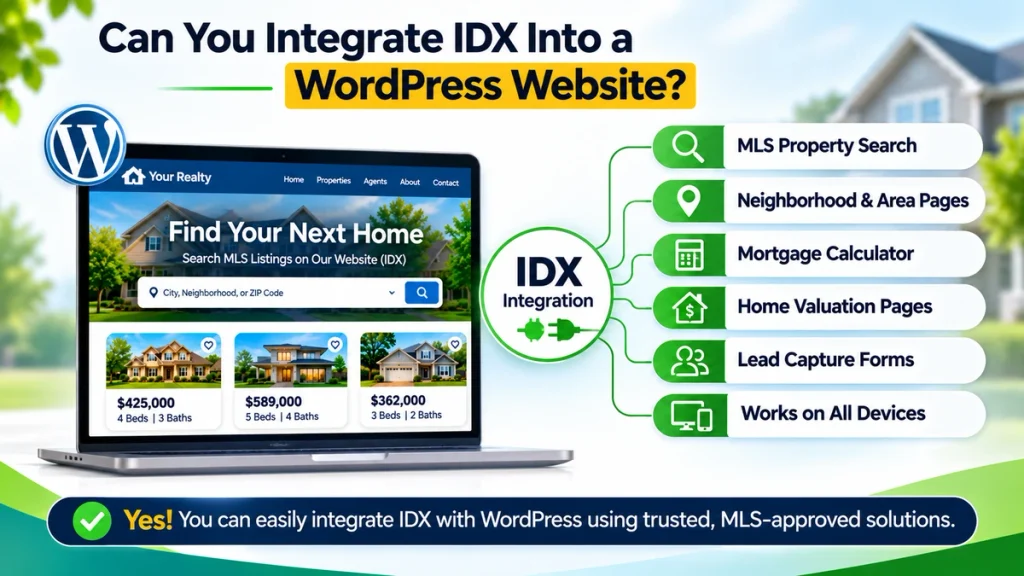
A WordPress website can combine IDX functionality with other useful features, such as:
- Custom homepage and agent profile pages
- Property search and listing pages
- Neighborhood and community pages
- Contact and inquiry forms
- Mortgage calculators
- Home valuation forms
- CRM integrations
- Automated lead notifications
The important part is making sure the IDX experience works well with the rest of the website.
For example, property search should be easy to find, listing pages should match the website’s design, and inquiry forms should provide a straightforward way for visitors to contact the agent.
A properly planned integration can help create a more complete website experience without making the property search feel like a separate product.
Frequently Asked Questions About IDX and MLS
What Is IDX in Real Estate, and What Does It Stand For?
IDX stands for Internet Data Exchange. It refers to the policies and arrangements that allow participating real estate professionals to display eligible MLS listing information on their websites and other approved digital platforms.
What does MLS stand for in real estate?
MLS stands for Multiple Listing Service. It is a system used by real estate professionals to share property listing information and support cooperation between agents and brokers.
Is IDX the same as MLS?
No. MLS is the listing service that maintains and shares property information among authorized professionals. IDX provides a permitted way to display eligible MLS listings on participating websites.
Do real estate agents need IDX on their websites?
Not every agent needs IDX, but it can be valuable for agents who want visitors to search for available properties directly on their websites.
The decision depends on the agent’s market, business model, budget, and website goals.
How does an IDX feed work?
An IDX feed or data connection provides eligible MLS listing information to an authorized IDX solution. The solution then displays permitted listings on the participating real estate website according to the applicable MLS rules and technical requirements.
Can you integrate IDX into a WordPress website?
Yes. Several IDX providers offer WordPress-compatible integrations. The available options depend on the provider, MLS coverage, authorization, and the website’s technical setup.
Does IDX automatically update property listings?
IDX solutions are designed to receive listing updates through their supported data connections. However, update frequency and technical requirements depend on the relevant MLS rules and provider.
How much does IDX integration cost?
The cost varies depending on the IDX provider, MLS, website platform, setup requirements, and additional features.
Some providers charge recurring subscription fees, while website development or customization may involve separate costs. Request a detailed quote before choosing a solution.
Why IDX and MLS Matter for Your Real Estate Website
MLS and IDX play different but complementary roles in helping real estate agents display property listings online. The MLS provides the listing information shared among real estate professionals, while IDX allows eligible listings to be displayed on an agent’s website, subject to applicable MLS rules and permissions.
When properly integrated, they can help you offer visitors an easier way to explore properties, improve their website experience, and create more opportunities for inquiries. However, choosing the right IDX solution and ensuring it works smoothly with your website are important steps.
At Web Care Tec, we build real estate websites with IDX/MLS integration to help agents create professional property search experiences and turn website visitors into potential leads.
Looking to add IDX/MLS integration to your real estate website? Contact Web Care Tec to discuss your project.